
- Home
- Our Business
- Key technologies
- Fluorine-free Aqueous Film-Forming Foam (AFFF) Technology
Fluorine-free Aqueous Film-Forming Foam (AFFF) Technology
Kao’s Foam Control Technology for PFAS-Free Firefighting Foams
Kao has developed a new formulation for firefighting foams that achieves performance comparable to conventional fluorine-based foams without the use of PFAS (per- and polyfluoroalkyl substances), which have raised global environmental concerns.
Traditionally, aqueous film-forming foams (AFFF) relied on the unique properties of PFAS, but their environmental impact has been a critical issue. By combining our core expertise in interface and foam control technologies, Kao has succeeded in creating a PFAS-free solution that delivers excellent wettability and spreading properties, offering a new option in fire suppression technology.
Looking ahead, Kao aims to advance this technology toward practical applications in collaboration with firefighting equipment manufacturers and related partners. Through performance evaluations and field testing, we will establish this as a technology that meets the diverse needs of firefighting operations.
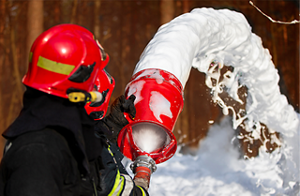
Types of Firefighting Foams and the Challenge of Going PFAS-Free
Types and Features of Firefighting Foams
Currently, three main types of foams are used in firefighting: aqueous film-forming (AFFF), protein-based, and synthetic surfactant-based. Each is selected according to the fire characteristics and environment, with its own advantages and disadvantages.
Aqueous film-forming foams (AFFF), in particular, have been widely used around the world due to their superior performance. However, in recent years, growing environmental concerns have led to increasingly strict regulations on the use of PFAS, creating industry-wide demand for PFAS-free solutions.
| AFFF (Aqueous Film-Forming) | Protein-Based | Synthetic Surfactant-Based |
|
|---|---|---|---|
| Advantages | Excellent oil and fire resistance; rapid fire suppression | Strong foam film, high heat resistance, good adhesion to vertical surfaces, prevents fire spread | Versatile foam generation |
| Disadvantages | Typically contains PFAS | Foam easily contaminated by oil, odor from protein sources | Weaker fire resistance |
| Applications | Life-critical firefighting, hydrocarbon spill fires | Large petroleum storage tanks | Enclosed spaces such as warehouses |
The Difficulty of PFAS-Free Formulation
PFAS are known for their exceptional stability and properties such as heat resistance, chemical resistance, and low surface tension. These features enabled high wettability on oil surfaces and sustained fire suppression in AFFF formulations.
However, due to their extreme persistence in the environment, PFAS are often called 'forever chemicals.' They do not readily degrade in nature, raising long-term environmental and health concerns.
Although research into alternatives is ongoing, replicating the unique properties of PFAS remains a major technical challenge, particularly in high-performance applications such as AFFF.

Establishing PFAS-Free Alternatives in Firefighting Foams
While PFAS have been widely used as key materials across industries, Kao has created a new technology specifically for firefighting foams, where environmental exposure is unavoidable. In particular, for aqueous film-forming foams (AFFF)—the category with the highest PFAS usage—we have established a new solution that does not rely on fluorinated compounds.
This innovation offers customers an effective alternative in the global shift toward PFAS-free solutions, while helping reduce environmental impact.
Why Kao Can Deliver PFAS Alternatives
Kao has decades of expertise in foam science through the development of consumer products such as shampoos and laundry detergents. This has allowed us to refine our core technologies in surfactant-based interface control.
In agriculture, we have also advanced wetting control technologies to ensure efficient adhesion of pesticides onto hydrophobic leaf surfaces. This involves molecular-level design of liquid spreading and adhesion—an essential foundation for manipulating foam and interface behavior.
By merging our agrochemical expertise in interface control with our consumer product expertise in foam control, Kao has successfully formulated a PFAS-free AFFF with both high wettability and spreading performance.

Key Features of Kao’s PFAS-Free AFFF Technology

Completely PFAS-free
(no fluorinated compounds)

Excellent spreading and film-forming for effective fire suppression

Compatible with existing firefighting equipment (no modification required)

Strong oil resistance to prevent burn back

Easy foam removal after fire suppression
Comparison with Existing PFAS-Free Technologies
While current PFAS-free foams are valued for their environmental compatibility, they often face challenges in spreading, oil resistance, and viscosity compared to fluorine-based foams. Leveraging its advanced interface control technology, Kao has achieved high performance across these parameters—without PFAS.
Spreading Performance
PFAS have enabled rapid spreading across oil surfaces through their high wettability, thereby achieving strong fire suppression performance. With Kao’s interface control technology, however, excellent spreading on oil surfaces has been realized without the use of PFAS.
Viscosity Control
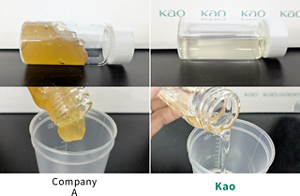
Kao’s technology achieves both stable foam formation and high fire suppression performance without increasing viscosity. As a result, no redesign or modification of firefighting equipment is required, making it directly applicable to existing systems.
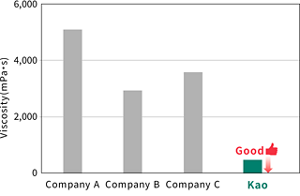
■ Measurement Conditions
-
*PFAS products A, B, and C: Measured with a Brookfield viscometer (at 20 °C)
-
*Kao product: Measured with a vibrational viscometer (at 20 °C)
Oil Resistance
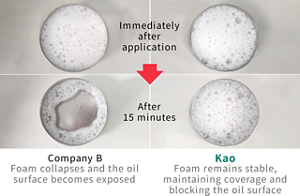
Like conventional PFAS-based technologies, Kao’s PFAS-free formulation forms a stable foam film on oil surfaces, suppressing the spread of flames. In contrast, some other PFAS-free technologies show rapid foam collapse, exposing the oil surface. Kao’s technology maintains foam stability, keeping the oil surface covered for an extended period and thereby preventing burn back.
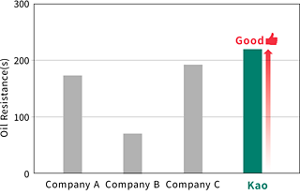
■ Measurement Conditions
-
-1Add 40 mL of foam extinguishing agent to a 300 mL cup.
-
-2Whip with a pencil mixer until the foam reaches a height of 200 mL (target expansion ratio: 5×).
-
-3Place 5 g of the generated foam onto the surface of 15 mL of n-heptane.
Optimal Foam Retention
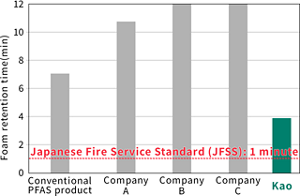
The ideal foam agent should maintain coverage during firefighting but allow easy removal afterward. Many existing PFAS-free foams remain excessively stable, leaving large amounts of foam to be cleared. In contrast, Kao’s formulation ensures sufficient retention during fire suppression while enabling quick and easy cleanup.
Global Deployment of Kao’s Technology
Kao envisions this technology being utilized across a wide range of firefighting scenarios worldwide. In particular, we seek to advance joint development and demonstration with firefighting equipment manufacturers and related partners who are committed to PFAS-free solutions.
We welcome opportunities for joint evaluation, sample testing, and verification of physical properties to prepare for field evaluation. Please contact us through the inquiry form below for further details.
- Home
- Our Business
- Key technologies
- Fluorine-free Aqueous Film-Forming Foam (AFFF) Technology
